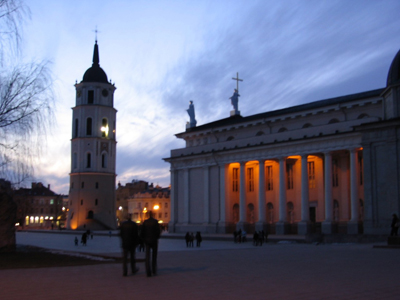
The Cathedral
Vilnius Cathedral is Lithuania's spiritual and political center.
It is thought that in pagan times this was the location of an altar, an eternal fire, or even a temple to Perkūnas. King Mindaugas built the original cathedral in 1251 after his conversion to Christianity. In 1387, on the occasion of the official conversion of the whole of Lithuania to Christianity, a gothic style cathedral was built. The coronation ceremonies of the Grand Dukes of Lithuania from Vytautas to Žygimantas Augustas took place there. Due to fires, wars, and unstable ground, the Cathedral was rebuilt more than once. As a result, gothic, renaissance, and baroque styles are reflected in its architectural history.
The most beautiful part of the Cathedral, the baroque chapel of St. Casimir, was built in 1623 - 1636 at the initiative of King Sigismundus Vasa. The chapel contains a unique 18th century goblet-shaped pulpit and 18th century silver-plated statues of the Grand Dukes of Lithuania and Kings of Poland. After the last reconstruction was performed according to the design of Laurynas Stuoka-Gucevičius, the church acquired the strict quadrangular shape favored by French classicism. The Cathedral was the most monumental building with the purest classical style in the entire territory of the Polish-Lithuanian state (Rzeczpospolita). Now, a tall portico with 6 Doric columns and sculptures by the Italian sculptor, T. Righi, which stand in the niches, decorate the main facade of the Cathedral. The tympanum portrays the sacrifice of Noah.
The interior of the Cathedral is also very rich: there are more than 40 artworks from the 16th - 19th centuries inside, both frescoes and small and large pictures. A museum, with an exposition reflecting the history of the building from the pagan temple until the present day, is located in the Cathedral's catacombs. During the restoration of the Cathedral, the very first floor, laid in the days of Mindaugas, was found in addition to the remains of the cathedral built in 1387, the altars of a pagan temple, and other archaeological finds. A fresco dated to the end of the 14th century, the oldest known fresco in Lithuania, was found on the wall of one of the underground chapels.
The Cathedral's bell tower (57 m or 187 ft) was built atop a Lower Castle defensive tower. Its oldest underground square section was even built in the 13th century on the bottom of the old riverbed. The bell tower acquired its present appearance after the 1801 reconstruction.
For a good choice of hotels with discount prices, visit Place to stay in Vilnius for more information.